 Come out to see In Your Own Backyard: Images from the Austin Astronomical Society, our first AAS Astrophotography Exhibit!
The exhibit has been extended until August 2017 @ the Texas Museum of Science & Technology.

Come out to see In Your Own Backyard: Images from the Austin Astronomical Society, our first AAS Astrophotography Exhibit!
The exhibit has been extended until August 2017 @ the Texas Museum of Science & Technology.
 March and Early April are one of the most amazing times in the celestial calendar. In the Northern Hemisphere (depending your latitude), on nights from late March through to the first couple of weeks of April, astronomers can view a good rotation of the night sky. If you’re intrepid, from dawn to dusk, there’s the opportunity to see ALL of the objects in Messier’s catalog!
M1 – M110 will be available, but it is a challenge to see them all. But, many amateur astronomers have taken up this challenge – to see all 100, or at least a majority of them, during a 10-11hr window. There IS a real strategy to achieve this goal, but it is doable! It is a real testament to an astronomer’s stamina, astronomical planning, observing, and logging skills to achieve it.
We are ready for volunteers to sign up for the 2nd Annual Texas Night Sky Festival®. The main event takes place on March 18th from 2:00 pm to 10:00 pm at the Dripping Springs Ranch Park at 1042 Event Center Drive. The center is located 1.7 miles north of Dripping Springs off RR 12, across from the DS Elementary School.
We have volunteer opportunities on Feb 26th, March 17th, 18th, 19th & 20th.
This year we are using SignUp.com which is the leading online sign up and reminder tool to organize the sign up of our volunteers for the TNSFestival.
Just a reminder that our February General Assembly meeting will be on a new night: Tuesday, Feb 7.
Same location: Room 2.136 of the Engineering Teaching Center on the NW corner of Dean Keeton and San Jacinto, on the UT campus.
Practical Astronomy kicks off at 6:30.
Our Practical Astronomer Dawn Davies will speak on the topic of Citizen Science.
General Assembly meeting starts at 7:30.
Our featured speaker will be Frank Mikan. Frank’s talk will focus on astronomy education with a discussion of science education in general over the past 50 years.
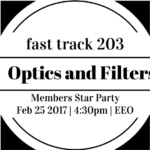 What is the difference between a 20mm eyepiece and a 25mm eyepiece? What does 60°, 80°, 100° really mean and why is it important? I see two 20mm eyepieces, but one is 1″ vs 2″ – what’s the difference? Why does my object look different on my 6″ vs someone else’s? Or – why is it very challenging to view The Horsehead Nebula, when I know I’m right on it?
Join us for the next Fast Track event which focuses on Optics and Filters! Bring eyepieces and your scopes, and we’ll talk about the differences in eyepieces (and what focal length really affects), understand a field of view, and learn some of the quick calculations so you can understand what optics should work better for your equipment ahead of making these critical purchases.
We will also look at the techniques around selecting filters: what are they, how do they help, what is the composition of our objects, and why do they help immensely for some observing and certainly towards capturing images.
And as always, once we finish the daytime class portion, we’ll set up our telescopes and practice using these techniques or learn how to anticipate and see the differences in combinations.
Terry Phillips has agreed to lead us again, and I’m sure it’ll be awesome!
Please bring your astrokit, along with your log for classroom notes and observing notes. You’ll also want to prepare for cool weather, chairs, snacks. We may view a few things inside the observatory as well.
As always, please sign up so we have enough materials for the night. And yes, it’s a members-only event! Any questions, please contact Member Services team!
Just a reminder that our January General Assembly meeting will be on a new night: Monday, January 9.
Same location: Room 2.136 of the Engineering Teaching Center on the NW corner of Dean Keeton and San Jacinto, on the UT campus.
Practical Astronomy kicks off at 6:30.
Brian Lippincott will speak on “Making your own parallel mount and some physics to go with it“.
General Assembly meeting starts at 7:30.
Our featured speaker will be Matt Lara, who will speak on: “Protecting the Starry Night Skies of the Hill Country”.
| Clear Sky Charts |


