Articles By Sean Leary

Austin Under the Stars

Austin Astronomical Society,  in collaboration with St. Stephen’s Episcopal School, brings to the public Austin Under the Stars (AUTS). For the 22nd year, AUTS brings the spectacles of the night sky to the Austin community. This special event, free of charge, is scheduled from 5:00 p.m. to 10:00 p.m. on Saturday, October 26, and will take place on Phipps Field and in the Spartan Fitness & Wellness Center on the St. Stephen’s Episcopal School campus off of the Capital of Texas Highway at 6500 St. Stephen’s Drive, 78746. The event will kick off with amateur astronomers from the AAS providing safe solar viewing and hands-on activities before moving into darker sky observing.  Back by popular demand this year will be planetarium shows in the mobile dome, air rocket launching, science micro-talks and ask an astronomer. There will be a bingo game for children 12 and under with a telescope for the winner in a random drawing.

AUTS is a great event for the entire family. You may bring a picnic (no alcohol). Service animals are welcome, but please leave pets at home. 

If skies are cloudy, you can check back here after noon on the 26th for information about cancellation.

Professor Steven Weinberg to Speak at the Next GA Meeting, July 12, 2019

Austin Astronomical Society

Presents

Professor Steven Weinberg

Department of Physics Theory Group

University of Texas – Austin

Nobel Prize (Physics), 1979

National Medal of Science

Member of the and National Academy of Science

Fellow of Britain’s Royal Society and other academies

S. Josey-Welch Foundation Chair in Science and Regental Professor

Director Theory Research Group. Particle physics, unification of fundamental interactions, cosmology, astrophysics, supersymmetry, supergravity.

Dr Weinberg’s Presentation

“Gravitational Wave Astronomy”

Dr Weinberg, who is an exciting and accomplished speaker, will talk about a new kind of astronomy that has recently begun, with the detection and analysis of gravitational waves from distant sources.


Don’t miss Dr. Weinberg’s presentation at the Austin Astronomical Society’s July 12th 7:30pm Meeting on the UT Campus – Mechanical Engineer Building, ETC rm. 2.

For a more complete bio: https://web2.ph.utexas.edu/~weintech/swbio.html


For more information regarding the meeting location, time, and date: https://austinastro.org/index.php/event/aas-general-assembly-meeting-on-friday-july-12-2019

General Assembly Meeting on Friday, June 14, 2019

Save the date and don’t miss our next General Assembly meeting in June!


Texas State University regents professor Don Olson and faculty member Russell Doescher, the “Celestial Sleuths”, will present a talk about Astronomy and World War II.

The current month is an appropriate time to look back at the World War II D-Day invasion because June 2019 marks the 75th anniversary of the original events in Normandy on June 6, 1944. This talk will describe how astronomical factors affected the planning and the selection of the date for D-Day. The lunar phase and the Moon’s position in the sky were important for the airborne assault that began during the night of June 5-6, 1944. The lunar phase, the times of morning twilight and sunrise, and the times of low and high tides all were crucial factors for the amphibious landings on the early morning of D-Day.

The talk will also describe the significance of astronomy to five other World War II events: the sinking of the British battleship HMS Royal Oak in 1939, the Pearl Harbor attack in 1941, the Tarawa landing of the U.S. Marines in 1943, the sinking of the USS Indianapolis in 1945, and the famous VJ Day Times Square Kiss photograph on the day in 1945 that marked the end of the Pacific War.

For more information, including time, date, and location please click this link.

Public Star Party at Inks Lake State Park on July 6, 2019

Come out to our July Public Star Party at Inks Lake State Park!

The evening will begin at 8:00 p.m. for nighttime observing until 10:30pm.

This public is invited to share our telescopes to observe the sky. We’ll show such objects as planets, the moon, galaxies, nebulae, star clusters, and more.  Festivities will take place at Inks Lake’s Central Park just southwest of the park store.

There is no charge for the star party itself, but visitors must pay the park entry fee of $6 for ages 13 and up, with children 12 and under free. If you are coming just for the event, no reservations with either the park or us are required. If you want to stay overnight, go to https://tpwd.texas.gov/state-parks/ for more information about individual parks.
 A flashlight with a red bulb is good, but we have red cellophane we can use to cover a white light. Please do not bring a dog, unless it is a service animal; we prefer not to have dogs around the telescopes in the dark. Smoking is not permitted in the area of the telescopes because the smoke can damage optical equipment. Public consumption of alcoholic beverages is not allowed in state parks.
If the weather on a scheduled star party day seems questionable for viewing, you can check this website or call the state park office.
X marks the spot where the telescopes will be set up in the image below.

In Memoriam: Mark Johnston


Mark at his Ancient Skies Observatory

It saddens me greatly to report that AAS has lost one of its beloved night sky watchers.  Mark Johnston passed away Sunday around noon after a short illness. He was laid to rest in Liberty Hill cemetery on Thursday.  At 60, he was taken from us far too soon. He will be sorely missed.

Mark joined AAS in 2002, about a year before I did.  We sort of grew up together in the club. He was somewhat new to astronomy.  I had been doing it since childhood but had not been active for many years. We just naturally gravitated to being observing buddies.

Mark was an enthusiastic participant in the Astronomical League observing programs.  His awards included the programs for Messier, Double Star, Deep Sky Binocular, Binocular Messier, Binocular Double Star, Lunar, Caldwell Silver, Globular Cluster, Planetary Nebula Advanced, Carbon Star, Stellar Evolution, Outreach Stellar, and the Herschel 400.  Mark received his Master Observer award from the Astronomical League in 2014. Mark’s favorite observing program was the double star program, but his most cherished AL certificate was for the Caldwell list. To complete his silver award, Mark corresponded several times with Sir Patrick Moore (CBE HonFRS) about his observations. Sir Patrick wrote a very encouraging note on Mark’s certificate shortly before his death in 2012. Mark treasured that certificate.

Mark was a connoisseur of fine equipment.  He had a fondness for apochromatic refractors, and a weakness for top shelf eyepieces.  He was a fanatic about maintaining and organizing his gear. His tenure as AAS equipment chair was cut short because no one could maintain apparatus to his high standards – he was driving everybody crazy.  On many occasions, I took advantage of Mark’s tendencies by leaving my outreach abused eyepieces out where he could see them. It wasn’t long before he’d get so disgusted that he’d clean the whole lot. He derived many hours of pleasure just assembling scopes on mounts.  He was always looking to put together the perfect rig. He would pester his friends with emails seeking opinions – Which finder would look best on top of the TEC 140? Watching him work on his rigs was not too different from watching a bonsai master trim a twig.

The man loved his double stars.  I suppose that’s why he also preferred refractors.  He delighted in point star images with the Airy disk and a single refraction disk, perfect for teasing out the duplicity of tight pairs.  He also had an amazing memory for the binaries he’d observed. He could spend hours hopping from one obscure gem to another without having to look at a list or a chart.

Mark got in more observing hours than probably anyone I know.  Even if observing conditions were marginal he would spend innumerable hours out in his zero-gravity chair going over the whole sky with binoculars.  His man cave was his backyard observing gazebo that he called Ancient Skies and I liked to call Wood Henge. We spent many companionable nights out there listening to soft rock or new age while looking up.  

Mark also liked to write about his observations.  He wrote in a simple self-deprecating style that was appreciated by many club members who kept asking for “more reports Mark”.  That is how he is probably remembered best by many AAS members who may not have met him in person. I think he liked to play up a bit on not being an “educated” man, but he certainly worked with, hobnobbed with, and earned the respect a lot of persons carrying advanced degrees.


Professionally, Mark was a surgical technician assisting in a wide range of difficult procedures.  He could tell stories that would make your skin crawl, but he has had a hand is saving many lives. He was a great comfort to me visiting and reassuring me a couple of times when I had to go under the knife.  

The love of Mark’s life is his wife Beth whom he never stopped referring to as the “best thing that ever happened to me.”  All his friends would agree. She did so much to keep Mark on an even keel. We morn her loss. We are grateful for all the good times we had together, but it breaks our hearts to have to say of this intrepid watcher of the night skies, our self-styled StarMan that now his watch is ended.
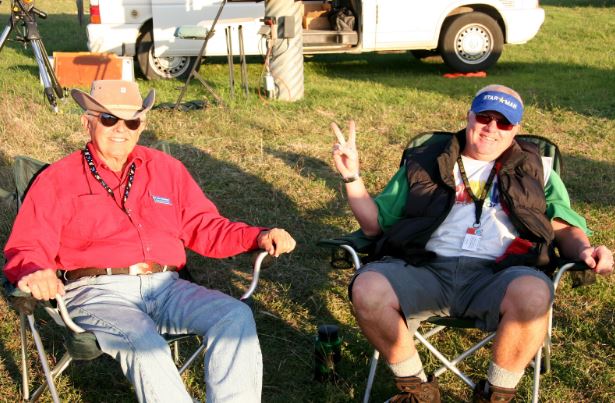
 

Mark (right) with one of his mentors, John Huntsberger, who also passed away last year.

By Terry Phillips
